Expert Insights
Office of the CIO

Dedale Intelligence’s take on Office of the CIO

Expert interview with Maxime Huig, Senior Associate at Dedale Intelligence, on the Office of the CIO segment: key trends, market dynamics, and technologies reshaping the software landscape

Written by :

Clémence Bouffard

March 11, 2026

Office of the CIO 2025: The Future of the CIO Software Stack

The terms “Office of the CIO” and “Office of the CTO” often get used interchangeably. How do you distinguish between them?

Maxime Huig: At Dedale Intelligence, we analyze this landscape through two main dimensions.

The first is core responsibility:

  • Development and engineering, typically the CTO’s remit.
  • Administration and operations, closely tied to the CIO.
  • Monitoring and observability, ensuring reliability, also under the CIO.
  • And security, which is the CISO’s domain.

The second dimension is the type of IT asset: front-layer assets like applications and devices, and back-layer assets such as infrastructure, databases, or cloud environments.

Thinking about CIO software through these two lenses, responsibilities and assets, helps clarify a very fragmented space.

Does customer adoption reflect this neat segmentation?

Maxime Huig: Not exactly. In reality, adoption is far more nuanced.

  • There are no universally accepted “mainstream” stack strategies.
  • Governance factors such as organizational size, budget allocation, and leadership strength play a decisive role.
  • Execution models vary a lot: some companies build in-house, while others rely heavily on managed service providers.

Broadly, large enterprises adopt more fragmented toolkits, combining multiple specialized solutions, while smaller organizations lean toward comprehensive platforms for simplicity and cost efficiency.

Governance, not technology, is often the biggest factor shaping CIO software choices.

Who are the main players shaping this market today?

Maxime Huig: The market is highly fragmented, but some clear leaders have emerged in each function:

  • DevOps – Atlassian, JFrog, GitLab
  • Administration – ServiceNow, Ivanti, Flexera
  • Monitoring & Observability – Dynatrace, Datadog, Elastic
  • Security – CrowdStrike, Palo Alto

Interestingly, players like ServiceNow are expanding beyond their core, from ITSM into monitoring and observability, to build more transversal offerings. Beneath these giants, there’s a long tail of niche vendors focused on specific use cases or IT assets.

The CIO stack is dominated by a few platforms, but beneath them lies a dynamic ecosystem of highly specialized vendors.

From an investment perspective, which areas look most attractive?

Maxime Huig: DevOps remains a high-growth segment, especially with AI-driven innovation in areas like code generation and automated testing.

In administration, ITSM is dominated by large players, but ITAM (asset management) has spawned numerous point solutions, for enterprise assets, software, and unified endpoint management.

Monitoring and observability continues to be very dynamic, with both platforms and niche tools offering strong differentiation.

And of course, cybersecurity remains vast, with prevention, detection, and response each generating their own sub-markets.

AI is reshaping many industries. How is it transforming the CIO software stack?

Maxime Huig: AI is a genuine game changer here. It enables automation, predictive insights, and faster resolution. It’s also raising questions about the long-term differentiation of some use cases, like software testing.

That said, most IT software solutions are deeply embedded and structural. They’re not easily commoditized by AI,  instead, AI enhances their value.

Take Dynatrace, which uses telemetry and contextual AI copilots for troubleshooting, or ServiceNow, which automates ticket resolution workflows. These are not just feature upgrades; they fundamentally shift customer expectations.

AI is no longer a bolt-on. It’s becoming the engine accelerating transformation across the CIO stack.

Looking ahead, how should CIOs think about their evolving software ecosystem?

Maxime Huig: CIOs should accept that fragmentation is here to stay. The key will be balancing specialized tools with integration, while leveraging AI to amplify value across the stack.

In practice, that means:

  • Using AI to streamline operations, monitoring, and resolution.
  • Building flexible architectures that allow coexistence of multiple best-of-breed tools.
  • And ensuring governance, leadership, budgets, priorities, aligns with the complexity of the IT estate.

The winners will be those who turn fragmentation into flexibility, using AI as the connective tissue across the CIO stack.

This interview is part of Dedale Intelligence’s ongoing series of expert insights, bringing research-driven perspectives on the most dynamic segments in software and technology. For more in-depth analysis, explore our latest articles, or contact us.

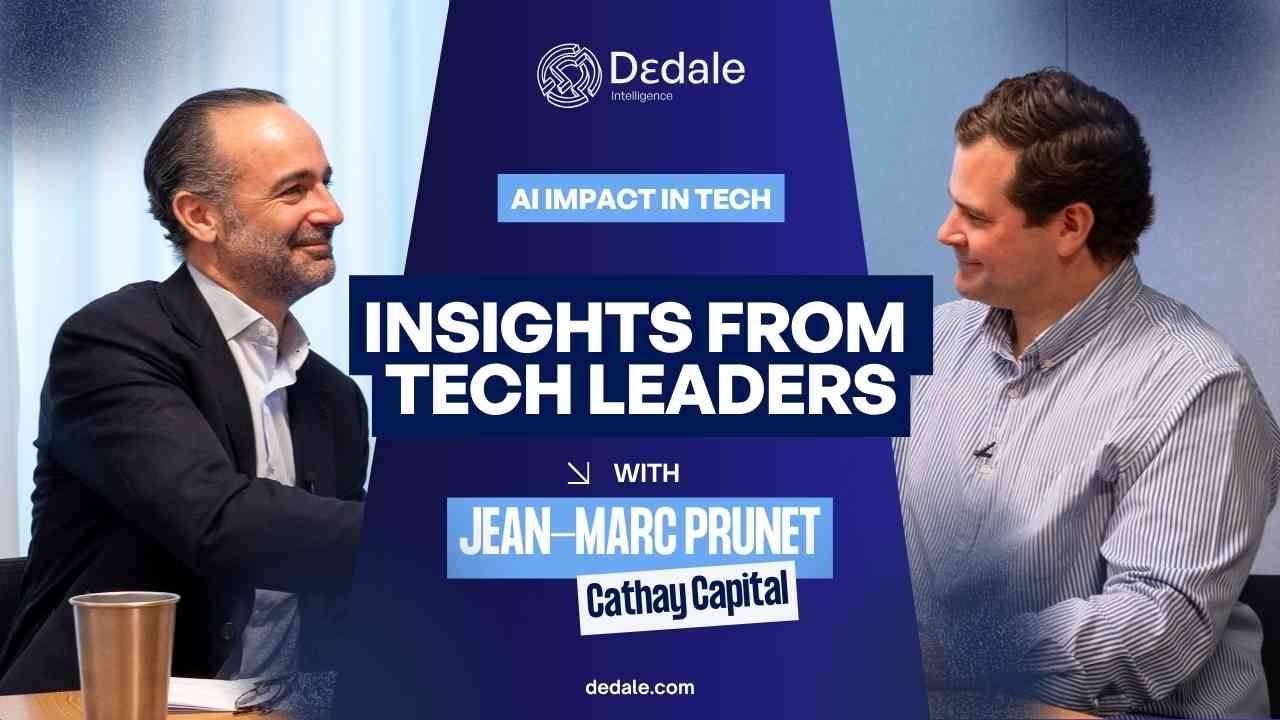
Inside AI, SaaS & Technology Investing with Jean-Marc Prunet
What’s next for AI and B2B software? Discover key insights from Jean-Marc Prunet, Partner at Cathay Capital, on SaaS, AI disruption, and technology investing
Artificial Intelligence
Supply Chain Technology: From Fragmentation to Execution
Dedale Intelligence insights on supply chain technology trends, from software integration and AI adoption to robotics and real-world operational execution
Supply Chain
Inside Healthcare Technology with Christophe Boutin
What’s next for healthcare technology? From fragmentation to AI, discover key insights from Christophe Boutin, former CEO of Maincare Solutions
Healthcare
Market trends March 2026
A comprehensive update on B2B software and IT services trends, including market performance, valuation dynamics, deal activity, and key names to watch
Market Update
The Financial & Market Data Industry: A Market Powering Global Finance
The financial and market data industry is a growing global market. Explore the key trends shaping data platforms, investors, and financial institutions
Office of the CFO
Dedale Intelligence's take on Industrial Software
Expert interview with Junhao Wang, Investment & Strategy Senior Manager at Dedale Intelligence, on the Industrial Software segment: key market pillars, vertical dynamics, platform concentration, and the growing role of AI and digital twins in manufacturing and engineering
Expert Insights
Industrial Software
Market Trends February 2026
A comprehensive update on B2B software and IT services trends, including market performance, valuation dynamics, deal activity, and key names to watch
Market Update
Dedale Intelligence's take on Cybersecurity
Expert interview with Pablo Rodrigo, Investment & Research Associate Manager at Dedale Intelligence, on the Cybersecurity segment: key market dynamics, fragmentation across assets and functions, the rise of managed services, and the accelerating role of AI in security.
Expert Insights
Cybersecurity
Growing Together at Dedale Intelligence
How a fast-growing team builds a strong, people-first culture through collaboration, shared values, and collective ambition
Inside Dedale
ServiceNow: Global IT Service Management Leader
From ITSM to enterprise workflow platform: a deep dive into ServiceNow’s strategy, growth drivers and competitive positioning
Office of the CIO
Category Leader

Get started

Dedale is growing fast and we are continuously looking to widen our reach in the ecosystem. Let's connect!

Members

Join our Community of Industry Veterans that we collaborate with to conduct deep research

Join the community

Investors, Corporates, and M&A Advisors

Learn more about how collaborating with Dedale Intelligence could enhance your intelligence generation efforts

Request an introduction

Talents

We are looking for smart, hungry, humble individuals to join our fast growing team worldwide!

Join the team